Specifications
| Metal | Gold |
| Purity | .9999 Fine (24 Karat) |
| Weight | 1 Troy Ounce |
| Form Factor | Coin |
| Diameter | 37 mm (1.46 in.) |
| Thickness | 2 mm (0.079 in.) |
| Face Value | 100 Euro |
Design & Liquidity
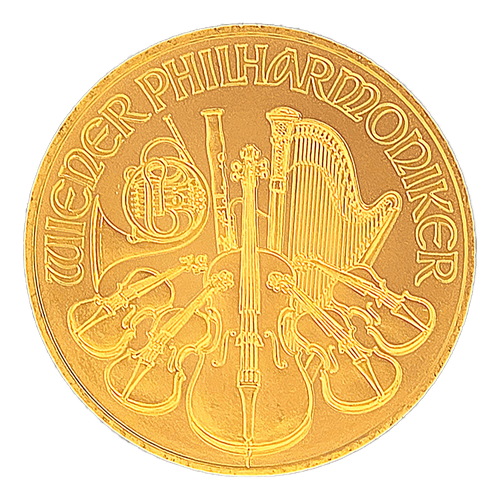
The Gold Philharmonic coin, officially known as the Vienna Philharmonic (Wiener Philharmoniker), features an iconic design created by Thomas Pesendorfer, the Chief Engraver of the Austrian Mint. The design was conceptualized and first released in 1989, and it has remained consistent each year, with only the year of issue changing.
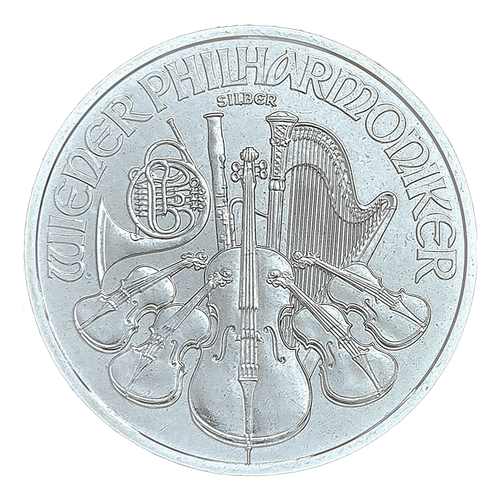
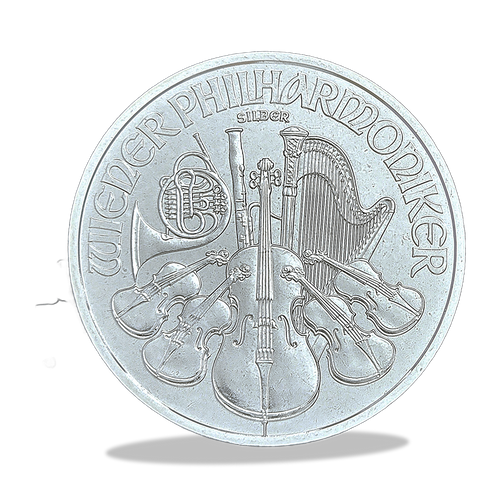
The obverse of the coin magnificently depicts the Great Pipe Organ found in the Golden Hall of Vienna's Musikverein, the esteemed concert hall home to the Vienna Philharmonic Orchestra. Inscriptions on this side include "REPUBLIK ÖSTERREICH" (Republic of Austria), the coin's weight, purity, and the year of issue. The reverse showcases a harmonious arrangement of musical instruments of the Vienna Philharmonic, prominently featuring a cello surrounded by four violins, a Vienna horn, a bassoon, and a harp. The inscription "WIENER PHILHARMONIKER" adorns the top of the reverse side.
The Gold Philharmonic is globally recognized for its artistic beauty and high liquidity, making it one of the world's best-selling bullion coins. It quickly became Europe's best-selling gold coin and ranked second worldwide in 1990. It achieved the title of the world's best-selling gold coin in 1992, 1995, 1996, and 2000, as recognized by the World Gold Council. Its universal recognition, competitive premiums, and backing by the Austrian government ensure it is easily tradable across international markets, particularly in Europe, North America, and Japan.
About the Mint
The Austrian Mint, known natively as Münze Österreich, boasts a rich and storied history spanning over 800 years, establishing it as one of the world's oldest and most respected minting institutions. Its origins famously trace back to 1194 when Duke Leopold V of Austria received a substantial silver ransom for the release of King Richard the Lionheart, using this silver to strike the first coins in Vienna. Today, it operates as a public limited company, a wholly-owned subsidiary of the Austrian National Bank, a structure it adopted in 1989.
The mint's undisputed flagship product is the Vienna Philharmonic series, which includes gold, silver, and platinum bullion coins. The gold Philharmonic, in particular, dominates the mint's bullion sales and is celebrated globally.
An intriguing historical fact is the mint's connection to the Maria Theresa Thaler, first struck in 1741. This coin achieved such widespread fame that restrikes of its 1780 version are still produced, solidifying its place as arguably the most renowned silver coin in the world. Furthermore, in 2004, to commemorate the 15th anniversary of the Philharmonic, the Austrian Mint created the colossal "Big Phil" – a 1,000-troy ounce (31.103 kg) gold coin with a face value of €100,000, of which only 15 were ever made.